
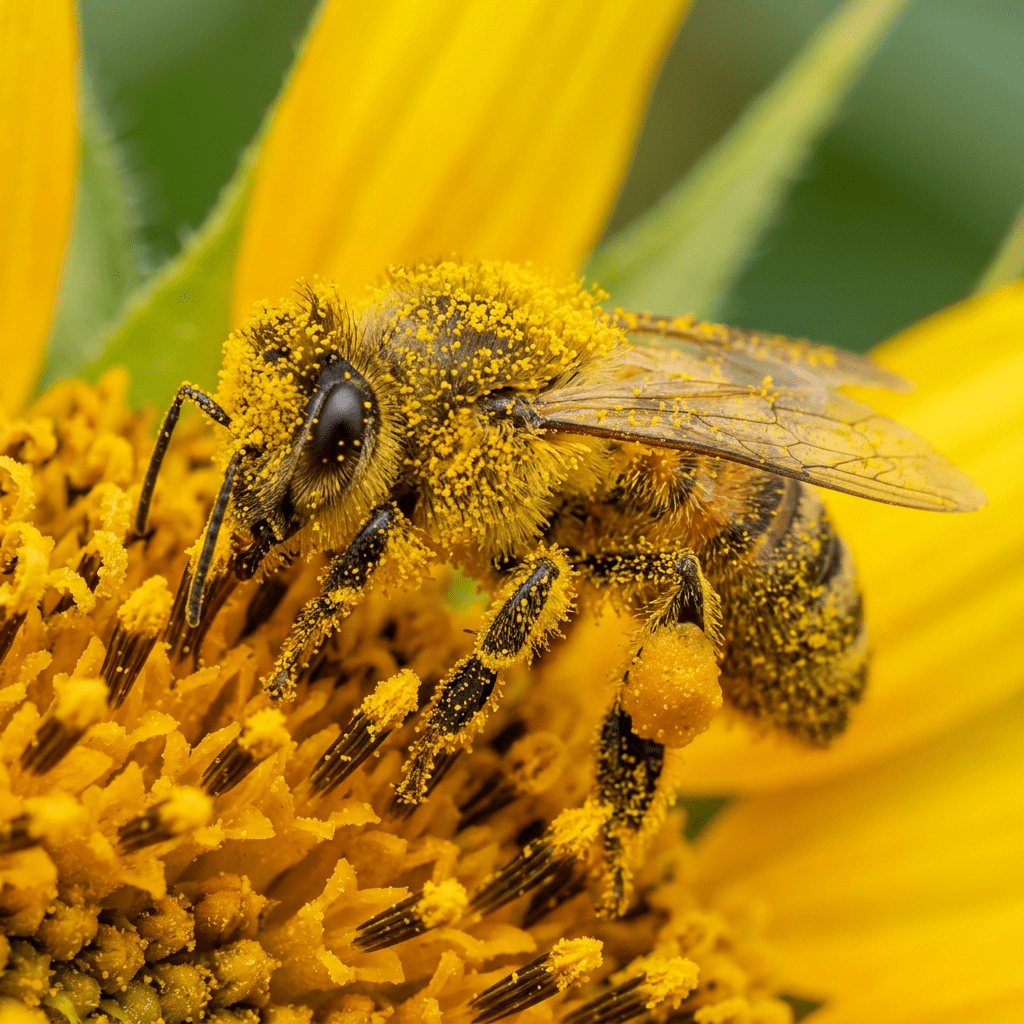
When most people think about food, they think about farms, grocery stores, or maybe soil and sunshine. But there is a quiet, tireless force working behind the scenes that makes much of our food supply possible: bees.
Without them, the natural system of plant reproduction—and the food webs that depend on it—would collapse in profound ways.
Pollination: The hidden foundation of food production
Pollination is the process by which flowering plants reproduce. It happens when pollen is transferred from one flower to another, allowing plants to produce:
- fruits
- seeds
- nuts
- vegetables
Bees are among the most efficient pollinators on Earth.
As they move from flower to flower collecting nectar and pollen, they unintentionally carry pollen with them, enabling plants to reproduce.
This is not just a helpful service—it is a biological necessity for many ecosystems.
Why bees are so effective
Bees are uniquely suited for pollination because:
- They are covered in tiny hairs that trap pollen
- They visit hundreds to thousands of flowers in a single day
- They demonstrate flower fidelity, meaning they often focus on one type of plant at a time, improving pollination efficiency
- They actively collect pollen and nectar to support their colonies, increasing plant-to-plant movement
This combination makes bees some of the most important pollinators in the natural world.
The foods that depend on bees
A large portion of the human food supply relies directly or indirectly on bee pollination. Even crops that are not fully dependent on bees often produce higher yields and better quality fruits when bees are present.
Bees and the wider ecosystem
Bees do far more than support human agriculture—they sustain entire ecosystems. When bees pollinate wild plants, they help:
- maintain biodiversity
- support wildlife food sources (berries, seeds, foliage)
- stabilize soil through plant growth
- sustain insect and animal populations up the food chain
In short, bees help keep natural systems functioning and balanced.
The challenges bees are facing
Despite their importance, bee populations have been under pressure due to:
- habitat loss
- pesticide exposure
- climate change
- disease and parasites (such as varroa mites)
- reduced plant diversity
When bee populations decline, the effects ripple outward into agriculture and ecosystems alike.
Why their decline matters for all species
Bees are not just important for humans—they are foundational for:
- herbivores that depend on flowering plants
- birds that rely on seeds and insects
- predators that rely on those birds and herbivores
When bees struggle, entire food webs become less stable.
A small creature with a massive impact
It’s easy to overlook bees because of their size, but their ecological role is enormous. They are not just pollinators—they are connectors of life systems, enabling plants to reproduce and ecosystems to thrive.
Without them:
- many crops would fail or become scarce
- wild plant diversity would decline
- animal populations would be disrupted
- food systems would become less stable and more expensive
Final thought
Bees remind us that some of the most powerful forces in nature are also the smallest. Their daily work—flower by flower, field by field—quietly sustains life across the planet.
Protecting bees is not just about protecting insects. It is about protecting the foundation of the food systems that sustain all species, including our own.
God said, Let the earth bring forth the living creature after his kind, cattle, and creeping thing, and beast of the earth after his kind; and it was so. Genesis 1:24
 abide & thrive